- Cat Labs Newsletter
- Posts
- How we used AI to make $750K in 6 months
How we used AI to make $750K in 6 months
A look at how the Physical Phones team uses AI across regulatory compliance, supply chain engineering, customer support, and strategy — and what it actually means for how we work.

Catherine Goetze
March 05, 2026
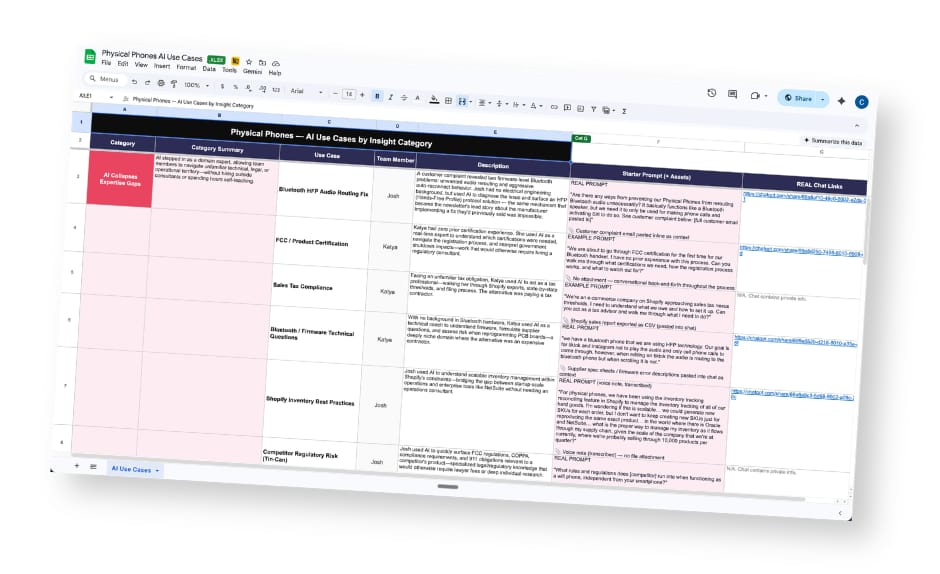
Want the list of use cases? Jump straight here: Physical Phones AI Use Cases
I've been thinking a lot lately about what it actually means to use AI well.
Not the hype version. Not "AI will replace your job" or "just ask ChatGPT anything." The real, practical, day-to-day version — what it looks like when a small team actually integrates it into their work in a way that moves the needle.
So I asked my whole team to document every meaningful way they'd used AI in the last few months. What they sent back was more interesting than I expected. Not because the individual use cases were flashy, but because of the pattern underneath all of them.
Three things kept showing up. And I think they're worth naming.
1. AI collapses expertise gaps
Here's a story that captures this better than anything.
Josh, who heading up all things product and has since been promoted to CEO of the company, identified that the number one piece of customer feedback we kept getting was that people didn't like how audio came out of the Physical Phone when they were scrolling Instagram or listening to Spotify in the background. When we brought this to our product manufacturer, they shut it down immediately: "Sorry, there's nothing we can do. That's just how Bluetooth works."

Josh didn't accept that. He took the problem to ChatGPT and started digging. ChatGPT suggested an electrical engineering workaround — one that Josh, who is not an electrical engineer, didn't fully understand. But he brought it back to the manufacturer anyway.
And they implemented it. And it worked.
That story still gets me. Because it's not really a story about AI. It's a story about what happens when the cost of acquiring working knowledge in a new domain drops to near-zero. Josh didn't need to become an electrical engineer. He needed enough to ask the right question and recognize a credible answer when he saw one.
We have dozens of versions of this across the team. Katya got our product FCC certified despite having zero prior experience in product certification. Maggie built an entire chargeback dispute strategy despite initially not knowing what a chargeback even was. These aren't small things — these are specialized, high-stakes domains that used to require hiring an expert or spending weeks climbing a learning curve.
What's shifted isn't that everyone on my team suddenly knows everything. It's that the bottleneck shifted. The question is no longer "do we have someone who knows this?" It's "do we have someone with enough judgment and the right instincts to ask good questions and evaluate what comes back?"
A 4-person startup can now credibly operate across regulatory compliance, supply chain engineering, tax, customer support, product strategy, and marketing — not because everyone is an expert, but because AI acts as a real-time domain coach that gets high-agency people to competent execution fast.
This is different from using AI as a glorified Google search. You're not just getting information. You're getting a thinking partner who meets you where you are, explains the terrain, and helps you take the next step — in the domain you're actually standing in, right now.
2. AI structures human thinking
The most sophisticated use cases across my team followed the same pattern: a person dumps unstructured, chaotic thinking into AI, and what comes back is structure.
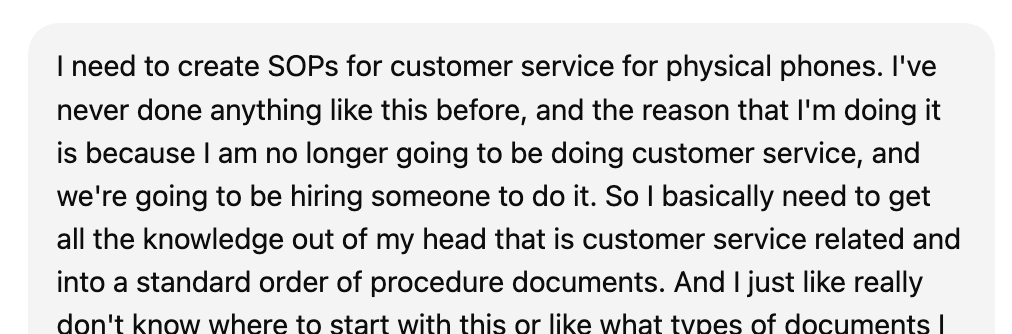
Josh rattled off a long voice note — every product feature floating in his head, every competitor we were benchmarking against — and got back a prioritized framework organized by impact and complexity. Katya wrote a messy first draft of a high-stakes email and got a restructured version she could actually edit and send. Maggie sat down before we hired a new customer support lead and used AI to extract everything she knew — all the tacit, lived-in knowledge she'd built up over months — into clean, documented SOPs that the next person could actually inherit.
This matters because the biggest bottleneck in most knowledge work isn't not knowing the answer. It's not being able to organize what you already know well enough to act on it.
Everyone on my team had the context and judgment to make good decisions. What they lacked was the time and cognitive bandwidth to turn messy, lived experience into something structured enough to be useful. The thinking originates with the person. AI is doing the labor of organization — which is the part of knowledge work that eats the most time and creates the most friction.
When you frame it that way, it starts to feel less like a tool and more like infrastructure.
3. AI is more useful for strategic work than most people realize
I think people dramatically underestimate this one.
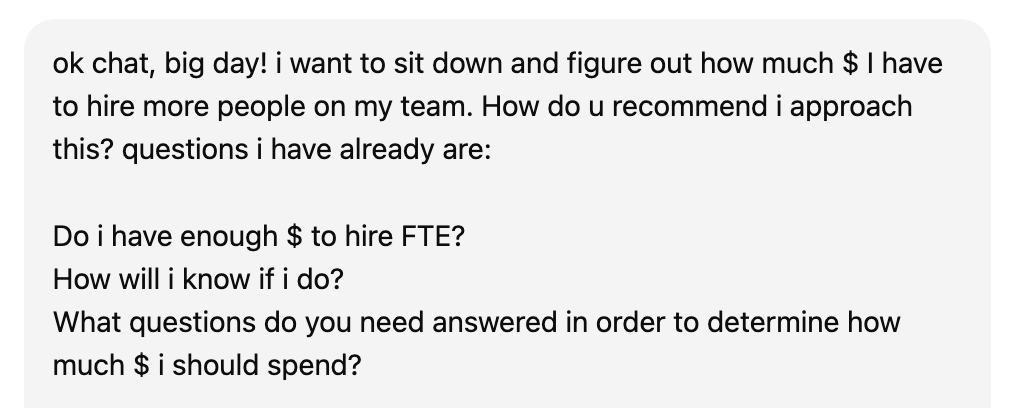
At the end of 2025, I needed to figure out how much we'd have to spend on hiring in 2026. Finances are the kind of thing I'll put off and put off until I feel ready — which, if I'm honest, can mean indefinitely. But because I had AI, I felt like I could show up with where I was at, messy and unresolved, and it would help me take the first step.
I told ChatGPT I wanted to sit down and figure out how much I had to spend on hiring. I said I wasn't sure how to approach it. I asked it to act like the friendly, smart, brilliant manager with an accounting and finance background that I needed — to ask me questions and walk me through it. And it did. What felt like a decision I'd been avoiding became a structured conversation I could actually finish.
That's what I want people to take away from this category. Not that AI gives you answers to hard strategic questions. But that it lowers the activation energy to start working on them — which, for a lot of us, is the actual problem.
The best advice I can give you for applying this to your own work: give AI harder problems with much less structured context.
Don't say "help me respond to this email." Say "I need to grow top-line revenue by 20% in the next three months. I'm going to ramble off some ideas and I want you to help me think through the pros and cons of each." Don't show up with a clean brief. Show up with what you actually have — half-formed, contradictory, uncertain — and let the structure emerge from the conversation.
What this looks like in practice
We put together a full breakdown of how each person on the team uses AI — organized by these three categories, with the actual prompts they used, the chat links, and an honest assessment of what it replaced and why it worked.
You can find it linked here.
Physical Phones are Bluetooth-enabled landline phones that connect to your iPhone or Android — so you can take enjoy the nostalgia of yesterday without throwing your smartphone into a river. Readers of my newsletter get 10% off! Use code CATNEWSLETTER10 at checkout.
 |  |  |